How long until hair loss treatment actually works?
- Hair is slow, and that is normal. You are growing biology, not flipping a switch. Real change takes months.
- First sign is usually less shedding, often around two to three months in, before you see any new growth.
- Visible density tends to arrive between six and twelve months, which is why a course is six sessions, not one.
- Keeping the hair you have counts as a win, because genetic hair loss is actively working against you.
- You will not have to guess. A baseline scan and set angle photos show whether it is working, in a record rather than the mirror.
It is the most reasonable question anyone asks before starting hair loss treatment, and often the one they are most anxious about: I am about to invest real money, so when will I actually see something?
You deserve a straight answer, not a vague "results may vary." So here is the honest, realistic timeline, and why hair works the way it does.
First, why hair is so slow
To understand the timeline, you need one simple fact about how hair works. Every follicle on your head runs on a cycle. It grows for years, then rests for a few months, then sheds that hair and starts again. At any given moment, your follicles are all at different points in this cycle.
Most of your hair is growing right now
Every follicle moves through three phases. Treatment works by coaxing more follicles into the growth phase, and keeping them there longer.
Growing (anagen)
The active phase, lasting two to seven years. The longer it lasts, the longer and thicker the hair.
Transition (catagen)
A brief winding down phase of a couple of weeks, as the follicle prepares to rest.
Resting (telogen)
A few months of rest, after which the old hair sheds and a new one begins to grow.
In pattern hair loss, that balance tips the wrong way. Follicles spend less time growing and more time resting and shrinking, producing finer, weaker hairs until some stop altogether. Treatment works by nudging those follicles back toward the growth phase.
But here is the catch: even once a follicle wakes up, the new hair still has to physically grow out, at about one centimetre a month. No treatment can rush that. It is biology, not a dimmer switch.
The realistic month by month timeline
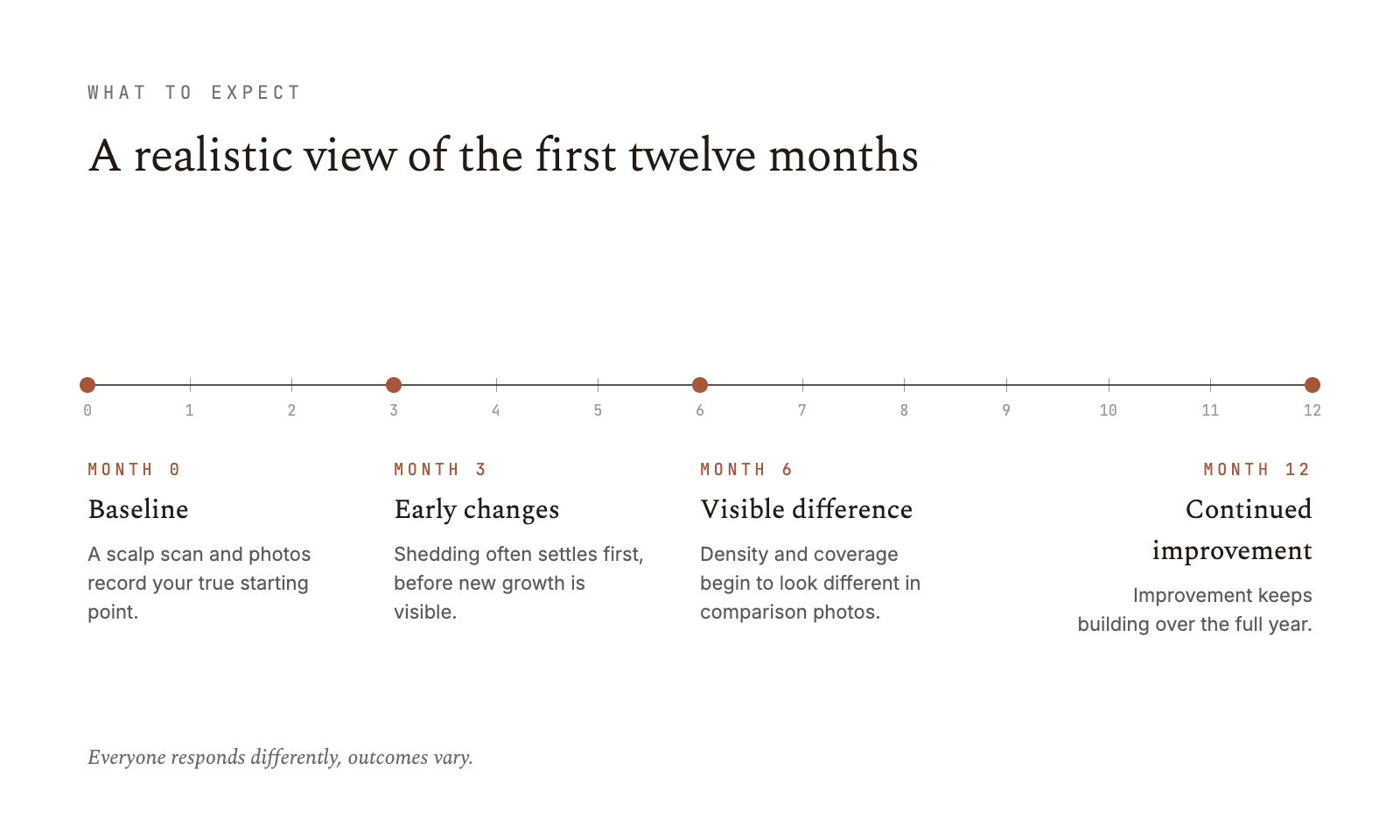
This is what a typical journey looks like across a six session course. Everyone is different, but this is an honest map.
What to expect, and when
Results build in stages. Knowing the stages in advance is the difference between patience and worry.
Quiet groundwork
Little to see yet. Behind the scenes, follicles are receiving the growth signals. Some shedding can even continue at first, which is normal.
Shedding slows
Often the first real sign. Fewer hairs in the brush and the shower. It is subtle, but it is meaningful.
Early regrowth
Fine new hairs begin appearing, sometimes as soft baby hairs along the hairline or part. Easy to miss without your baseline photos.
Visible density
The payoff window. New hairs thicken and mature, and improved density becomes visible to you and others.
Notice what happens first: not dramatic regrowth, but less loss. That is why we photograph your baseline and track from set angles, because the earliest wins are easy to miss by eye, and seeing them keeps you encouraged through the slow early weeks.
Why the course is six sessions
Now the timeline makes sense of the treatment plan. A single session gives your follicles one dose of encouragement, but follicles respond to consistency, repeated signals over time, spread across the growth cycle. That is why nearly everyone starts with six sessions, roughly one a month.
is when most people begin to see meaningful change, which lines up almost exactly with completing a six session course.
Thinking of it as a single appointment is the fastest route to disappointment. Thinking of it as a six month project, with visible payoff building toward the end and beyond, is both accurate and far more rewarding.
Start with the complimentary part
The consultation and scan cost nothing, and set the baseline that lets you actually see whether treatment is working.
Book a complimentary consultationWhat counts as success, honestly
This matters, because it reframes the whole money question. With genetic hair loss, your body is actively trying to shed and shrink certain hairs. It is a process working against you, every day.
So there are really two kinds of win:
- New growth, the obvious one, where thinning areas visibly fill in.
- Holding the line, the underrated one, where you keep the hair you have instead of continuing to lose it. Against a condition designed to take it, that is a genuine result, even without dramatic regrowth.
Anyone who promises you a guaranteed head of new hair is not being honest. What good treatment offers is the best chance of both wins, tracked properly so you can see what is actually happening.
We cannot guarantee results, because no one truthfully can. What we can promise is a measured baseline, honest tracking, and that if a treatment is not right for you, we will tell you before you spend a cent.
Crystal, Registered Nurse
Crystal is the founder of Scalp Series and a registered nurse who works exclusively in hair and scalp restoration. She holds a Graduate Diploma in Cosmetic Nursing and Injectables and a Master of Nursing Science, is currently studying toward certification as a trichologist with the International Association of Trichologists, and personally performs every treatment at the studio.
Medically reviewed before publication. Last updated July 2026.