PRP vs PRF for hair loss: what's the actual difference?
- Same idea, two generations. Both PRP and PRF use your own blood to feed your hair follicles with growth factors. PRF is the newer version.
- The real difference is timing. PRP releases its growth factors quickly. PRF traps them in a natural mesh and releases them slowly over about a week.
- PRF also keeps more of the good stuff, because it is spun gently and without chemicals, holding on to white cells and stem cells that PRP tends to lose.
- Neither is a gimmick. A 2023 review of clinical trials found PRP significantly improved hair density versus placebo. PRF builds on the same foundation.
- Best choice depends on you, and that is what a consultation and scalp scan are for.
If you have started looking into hair loss treatments, you have probably seen both PRP and PRF mentioned, often as if they are the same thing. They are closely related, but they are not identical, and the difference is worth understanding before you spend a cent.
Here is the plain English version, without the jargon.
First, what they have in common
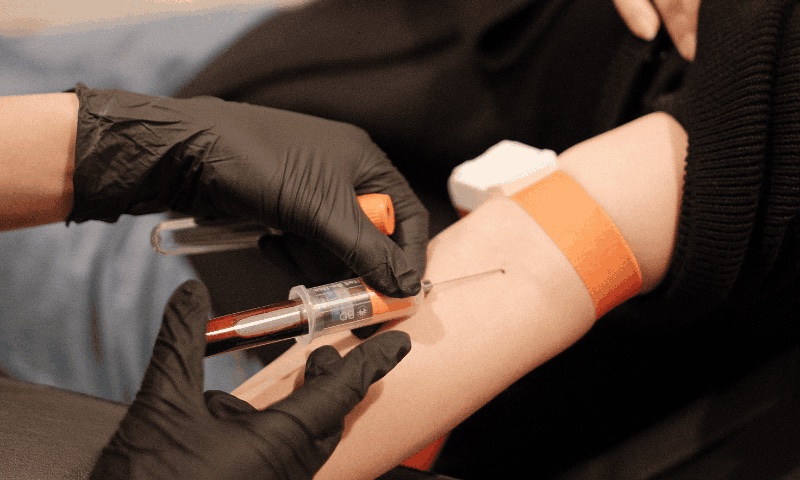
Both PRP (platelet rich plasma) and PRF (platelet rich fibrin) start the same way: with a small sample of your own blood, taken just like a normal blood test. That blood is placed in a machine called a centrifuge, which spins it quickly to separate it into layers.
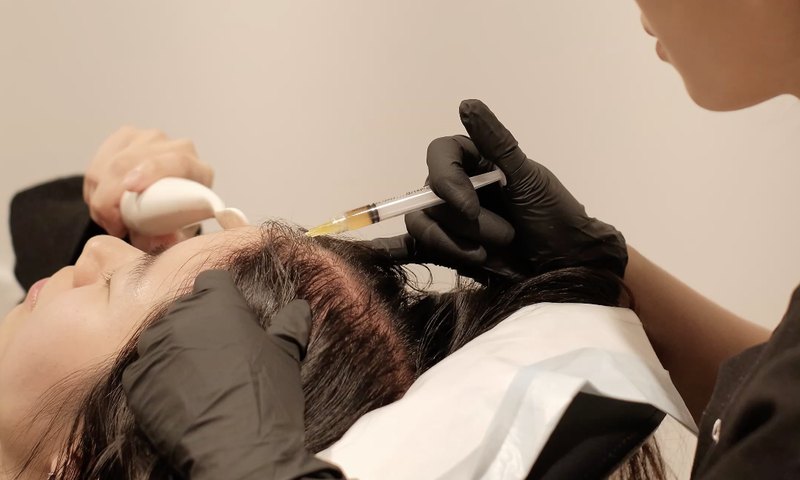
The layer we want is the one rich in platelets. Most people think of platelets as the cells that help you stop bleeding, which they do, but they are also little packages of growth factors: natural signals that tell your body to repair, rebuild and grow. When we place those growth factors back into your scalp with microneedling and fine injections, the goal is to wake up tired hair follicles and support them to produce stronger, thicker hair.
One part of this that rarely gets discussed is the system itself. Not all PRP is the same. The kit and the spin protocol determine how concentrated the plasma ends up and how much of the platelet yield is actually recovered, and that varies considerably between systems. We use T-Lab, which was ranked the number one PRP system in an independent comparative study presented at IMCAS World Congress 2025, and which is listed on the Australian Register of Therapeutic Goods. It is not something you can see from the chair, which is exactly why it is worth asking any clinic what they use.
Think of your growth factors as fertiliser for your follicles. Both PRP and PRF deliver that fertiliser. They just deliver it differently.
The real difference: how the growth factors are released
This is the part that actually matters, and it is easier to see than to read.
With PRP, your blood is spun fast, and a chemical called an anticoagulant is added to keep it liquid. You end up with a high concentration of platelets that, once injected, release most of their growth factors quickly, over roughly the first few days.
With PRF, there is no anticoagulant, and the blood is spun more gently and more slowly. Because nothing is stopping it, your blood does what it naturally does: it begins to form a soft fibrin clot, a fine mesh scaffold. Your platelets, white cells and stem cells get caught in that mesh. Once placed in your scalp, the mesh slowly breaks down and releases its growth factors gradually, over about a week or more.
A fast spike, or a slow release
The same growth factors, delivered on two very different schedules. This is the core difference between PRP and PRF.
Why does slow release matter? Because your follicles are not repaired in a single afternoon. A steady supply of growth factors over several days may give them more sustained encouragement than one large burst that fades quickly. That is the main theoretical advantage of PRF.
PRF also holds on to more
There is a second difference. Because PRF is spun gently and without chemicals, it keeps things that the faster PRP process tends to leave behind, including white blood cells and a small population of stem cells. These contribute to the repair signal. So PRF is not only a slower release, it is arguably a richer one.
Side by side
| PRP Platelet rich plasma |
PRF Platelet rich fibrin |
|
|---|---|---|
| Uses your own blood | Yes | Yes |
| Anticoagulant added | Yes, to keep it liquid | No, kept natural |
| How it spins | Faster, higher force | Gentler, lower force |
| Growth factor release | Quick, over a few days | Gradual, over a week or more |
| Keeps white & stem cells | Fewer retained | More retained |
| Often suits | Early thinning, an accessible entry point | Most presentations, our best value option |
So does any of this actually work?
Fair question, and the honest answer is that the evidence is promising but still maturing.
A 2023 systematic review and meta analysis of randomised controlled trials found PRP significantly increased hair density at three and six months compared with placebo.
Zhang et al., Journal of Cutaneous Medicine and Surgery, 2023. Nine trials, 238 patients.
Researchers are also clear that study quality varies and that larger, more standardised trials are needed, which is exactly the kind of honesty you should expect from anyone discussing these treatments. PRF is newer, so it has a smaller body of dedicated research, but it is built on the same well understood biology as PRP, with refinements designed to improve on it.
The practical takeaway: these are legitimate, evidence supported treatments, not miracle cures. They work best as a consistent course rather than a one off, and results build gradually. Anyone promising guaranteed regrowth is not being straight with you.
Two minutes to a starting point
Answer a few quick questions about your hair and we'll suggest a sensible place to begin, before you ever book.
Take the assessmentWhich one is right for me?
Here is the honest answer: it depends, and that is not a cop out. It depends on your pattern and stage of hair loss, your budget, and what your scalp scan shows. As a general guide:
- PRP is often a sensible, accessible entry point, particularly when thinning has only recently begun.
- PRF is the option we reach for most often, because its slow release and richer cell content suit the majority of presentations, and it is our best value treatment.
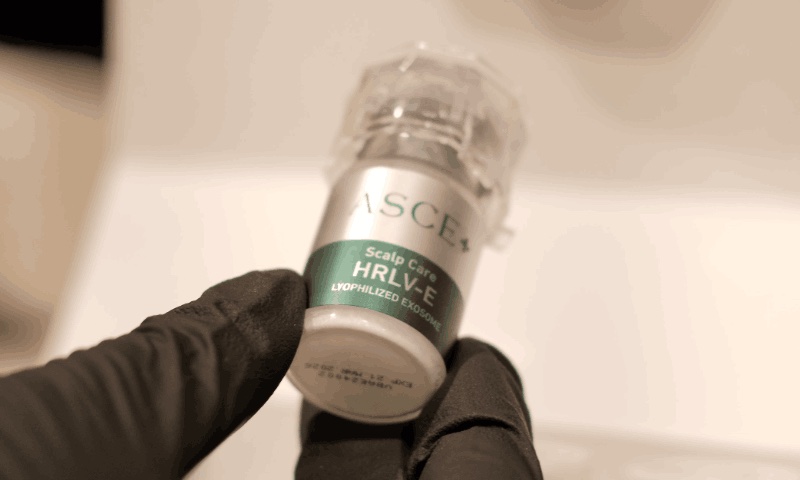
- Some people are best served by combining PRF with exosomes for a more comprehensive approach, though we only recommend that where it is genuinely warranted.
The right way to decide is not from an article, it is from an actual look at your scalp. That is what a complimentary consultation and scan are for.
Crystal, Registered Nurse
Crystal is the founder of Scalp Series and a registered nurse who works exclusively in hair and scalp restoration. She holds a Graduate Diploma in Cosmetic Nursing and Injectables and a Master of Nursing Science, is currently studying toward certification as a trichologist with the International Association of Trichologists, and personally performs every treatment at the studio.
Medically reviewed before publication. Last updated July 2026.