Tight hairstyles and thinning edges: traction alopecia explained
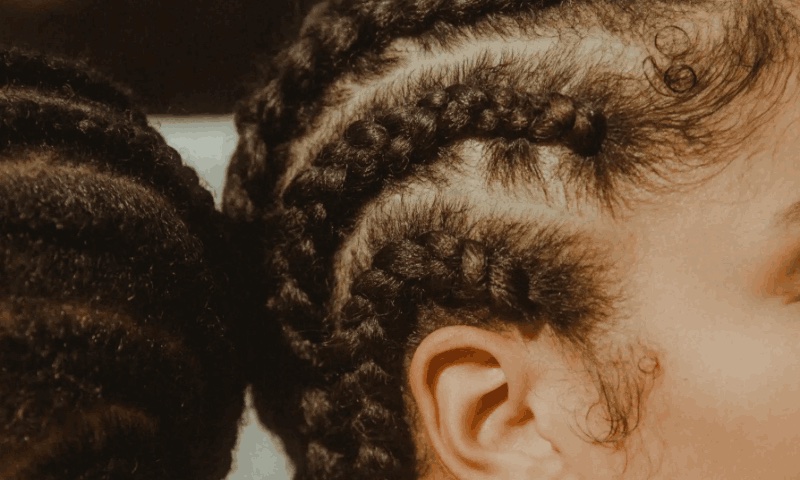
- Traction alopecia is hair loss from pulling, caused by tight ponytails, braids, buns, weaves and extensions worn under tension over time.
- It usually starts at the edges: the hairline and temples thin first, because that is where the pull is strongest.
- The mechanism is steady tension, which irritates the follicle, then, if it continues for long enough, damages it.
- Caught early, it is reversible. Ease the tension and hair often regrows over months.
- Left for years, it can become permanent, once the follicle scars over and stops producing hair.
- Early signs are the whole game: small broken hairs, tenderness or a receding edge are the moment to act.
Most hair loss creeps up quietly. This one you can often trace to a habit: the ponytail worn tight every day, the braids that felt a little too snug, the extensions that ached for the first two days. Traction alopecia is hair loss caused by pulling, and it is one of the few types that is genuinely within your power to change, if you catch it in time.
That last part is the whole story. Early on, it is reversible. Left alone for years, it may not be. Understanding the difference is what this article is for.
What traction alopecia is
Traction alopecia is hair loss caused by repeated or prolonged tension on the hair. Traction simply means pulling. When hair is held under strain, day after day, the follicle it grows from is placed under strain too. Do that gently once and nothing happens. Do it firmly and constantly for months or years, and the follicle starts to give way.
It shows up most often at the front and sides, the hairline and the temples, because that is where styles pull hardest. A telltale pattern is thinning just behind the very front edge, sometimes leaving a thin band of fine hairs stranded at the hairline while the area behind it recedes. Dermatologists call this the fringe sign, and it is a useful clue that pulling, rather than another cause, is at work.
Why the pulling matters: the mechanism
A hair follicle is anchored in the skin, with the living, growing part sitting deep at its base. Constant tension does two things. In the short term it irritates the follicle, which is why a too tight style can leave the scalp tender, red, or dotted with small bumps. This early stage is inflammation, and it is reversible.
If the tension keeps up, the damage moves from irritation to structural. The follicle is gradually worn down and, over time, can be replaced by smooth scar tissue. Once a follicle has scarred over, it no longer produces hair, and that is what makes late traction alopecia permanent. The shift from reversible to permanent is not a cliff edge on a set date, it is a slope, which is exactly why acting early matters so much.
Think of a young tree tied too tightly to a stake. Loosen the tie early and the bark recovers. Leave it biting in for years and the groove never grows back.
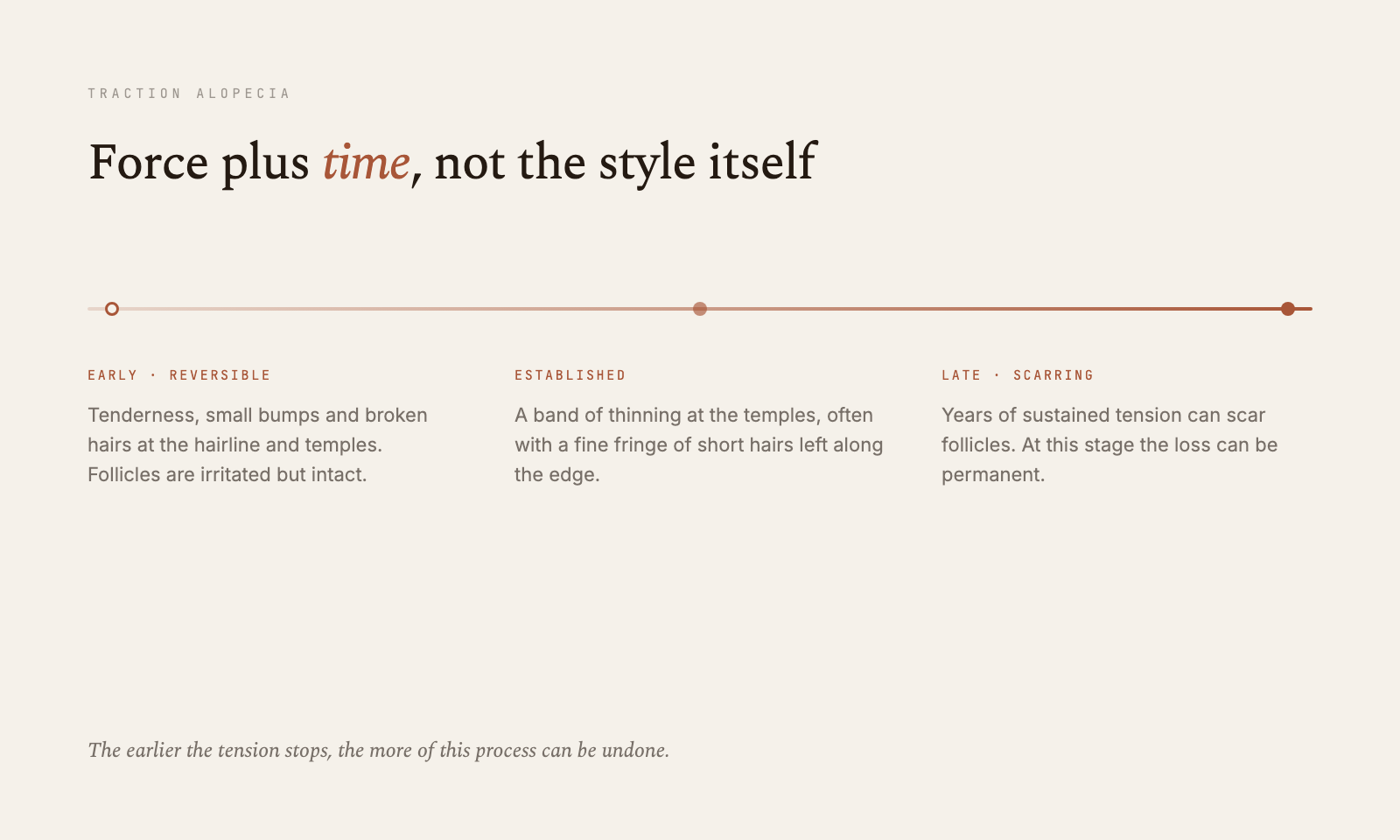
Traction alopecia is a slope, not a switch
The same force, sustained over more time, moves the follicle from irritated to worn to scarred. Where you catch it decides how much comes back.
Irritation
The follicle is strained and inflamed. Tenderness, redness or small bumps. Hair is intact and can recover once tension eases.
Thinning
The hairline and temples visibly thin, with short broken hairs. Still often reversible, but the window is closing.
Scarring
Worn follicles are replaced by smooth skin. Hair no longer grows there, and this stage does not reverse.
The styles most often involved
It is not any single hairstyle that is the villain, it is sustained tension, however it is applied. Common contributors include:
The common thread is force plus time. Tighter, heavier and longer worn styles carry more risk, and hair that is already chemically relaxed or heat treated is more vulnerable because it starts out weaker. Traction alopecia is well documented in people who wear these styles regularly. A 2018 review in Clinical, Cosmetic and Investigational Dermatology reported that it affects roughly one in three women of African descent who wear high tension styles over long periods, one of the more studied groups, though anyone who keeps hair under tension can develop it.
The early signs worth acting on
Because catching it early is what keeps it reversible, the early signs matter more here than in almost any other type of hair loss. Look for:
- Gradual thinning or a receding edge at the hairline and around the temples.
- Short, broken hairs along the front, or fine hairs left stranded right at the very edge.
- Tenderness, an itch, redness, or small bumps after wearing a style.
- A headache or soreness while a style is in, a sign it is too tight.
- Shed hairs that still have a small white bulb attached at the root.
None of these mean the situation is hopeless. They mean the opposite: they are the moment the problem is most fixable.
Early stage compared with long standing
The single most useful thing to understand is how differently the same condition behaves depending on when it is addressed. The table below sets the two ends of the spectrum side by side.
| Early stage | Long standing | |
|---|---|---|
| The follicle | Strained and inflamed, but intact. | Worn down and, in places, scarred over. |
| What you see | Tenderness, small bumps, early thinning, broken hairs. | Smooth, bare skin where hair used to grow. |
| Reversible? | Usually, once the pulling stops. | Scarred areas do not grow back. |
| What helps most | Easing tension early, gentle care, time. | Protecting the hair that remains; options discussed individually. |
What helps
The foundation of managing traction alopecia is not a product, it is removing the cause. Everything else is secondary to easing the tension.
- Loosen and vary your styles. Wear hair down or loosely tied where you can, and change where the tension sits rather than pulling the same spot daily.
- Rethink the tightest habits. Give the scalp regular breaks from braids, weaves and extensions, and take them out if they hurt. Pain is a signal, not something to push through.
- Be gentle with vulnerable hair. If your hair is chemically relaxed or heat treated, it tolerates tension less well, so combining the two raises the risk.
- Act on the early signs. Tenderness, bumps or a receding edge are worth addressing while the follicles are still intact.
There is no product that undoes scarring, which is why prevention and early action carry the weight here. If regrowth is slow to come once tension is removed, that is a reason to have the area assessed rather than to keep waiting and hoping.
If the thinning at your hairline or temples is not recovering after you have eased the tension, if you are seeing bare, smooth skin rather than fine regrowth, or if you simply want to know which stage you are at, an assessment can map the affected area and help tell reversible thinning from scarring. Knowing where you stand is what lets you make a calm, informed decision rather than guessing.
See your hairline clearly
A scalp scan can map thinning at the hairline and temples and help distinguish early, reversible traction from scarring. The consultation is complimentary.
Book a complimentary consultationCrystal, Registered Nurse
Crystal is the founder of Scalp Series and a registered nurse who works exclusively in hair and scalp restoration. She holds a Graduate Diploma in Cosmetic Nursing and Injectables and a Master of Nursing Science, is currently studying toward certification as a trichologist with the International Association of Trichologists, and personally performs every assessment at the studio.
Medically reviewed before publication. Last updated July 2026.