The hair growth cycle, explained simply
- Hair grows in a cycle, not continuously. Each follicle grows, transitions, rests and sheds, then starts again.
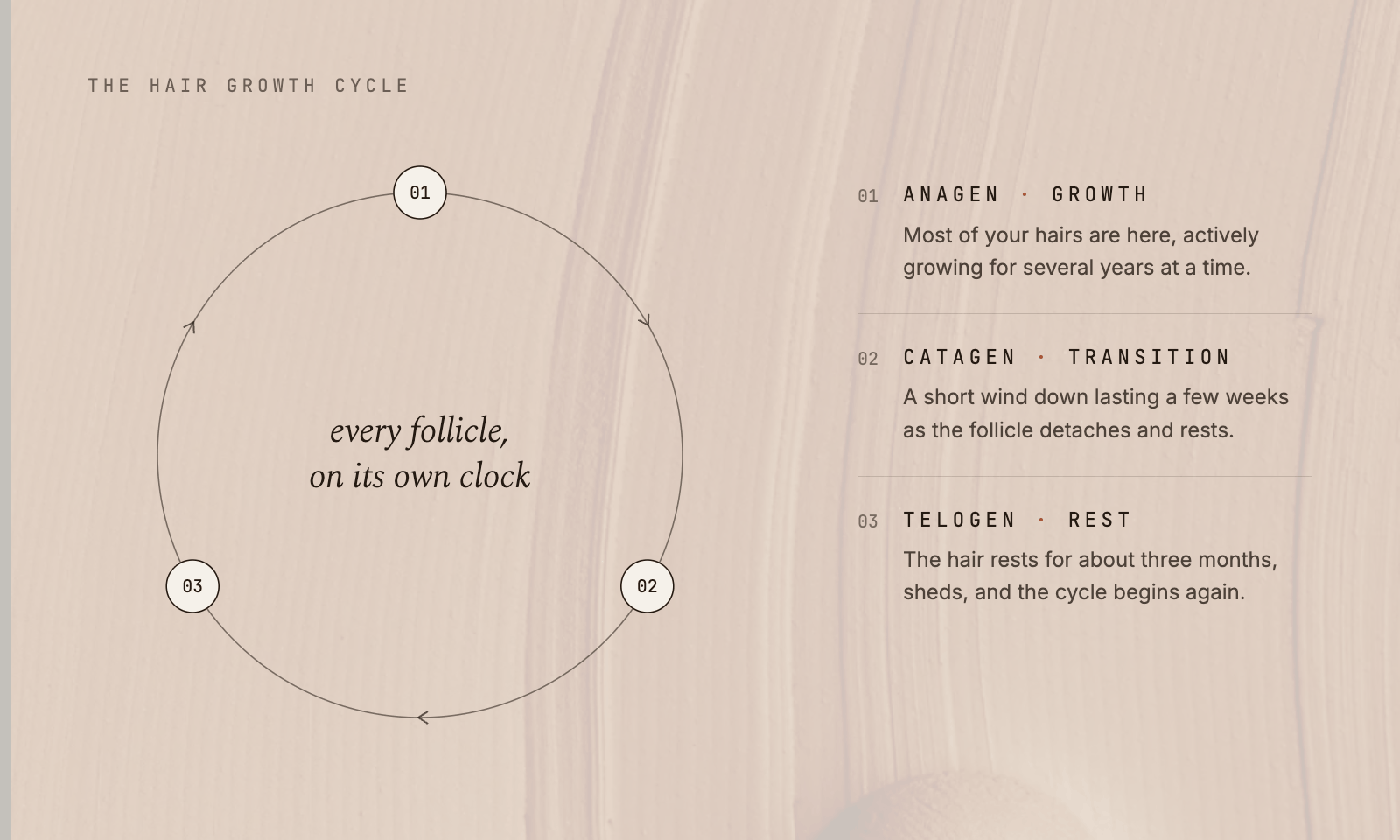
- There are three phases: anagen (growth), catagen (transition) and telogen (rest).
- Shedding is normal. Losing roughly 50 to 100 hairs a day is expected, because some follicles are always resting.
- Follicles cycle independently, which is why you are not bald between cycles.
- Most hair loss is a disrupted cycle, and it is also why treatment takes months to show.
Almost everything confusing about hair loss makes sense once you understand one thing: hair does not grow continuously. Each follicle runs through a repeating cycle of growing, resting and shedding. Get your head around that cycle, and daily shedding, delayed loss and slow treatment results all stop being mysterious.
The three phases
Every hair on your head is at its own point in a three part cycle. Because each follicle is on its own schedule, the whole head is never in sync, which is exactly why you keep a full head of hair despite shedding every single day.
Anagen, the growth phase
The long, active phase where the follicle produces a hair that keeps growing. Most of the hair on your head, the large majority at any moment, is in this phase. Its length is largely what determines how long your hair can grow.
Catagen, the transition phase
A brief winding down. The follicle stops actively growing the hair and begins to shrink and detach from its blood supply. Only a tiny fraction of hairs are here at any time.
Telogen, the resting phase
The follicle rests. At the end of this phase the old hair is released and sheds, and a new hair begins to grow underneath, restarting the cycle. The hairs you find in the shower or on your pillow are mostly these.
Think of your scalp as an orchard where every tree is on its own season. Some are fruiting, a few are turning, some are bare and about to bud again. The orchard always looks full because the seasons never line up.
Why you shed every day, and how much is normal
Because a share of your follicles are always in the resting and shedding phase, losing hair daily is completely normal. The often quoted figure is somewhere around 50 to 100 hairs a day, though this varies between people and with hair length and washing habits. A single count on a single day tells you little.
What actually matters is a sustained change from your own baseline. Noticeably more hair than usual, over weeks rather than one bad shower, is the signal worth paying attention to.
A scan measures it instead of guessing
An AI scalp analysis gives you a real baseline, so a change can be measured rather than worried over. The consultation is complimentary.
Book a complimentary consultationHow the cycle explains hair loss
Most hair loss is really a disruption of this cycle, and naming the disruption tells you what you are dealing with.
- Pattern hair loss gradually shortens the growth phase and shrinks the follicle, so hairs grow finer and for less time until some barely grow at all.
- Telogen effluvium pushes an unusually large number of follicles into the resting phase at once, so they shed together a few months later.
- Treatments work with the cycle, supporting follicles to spend longer growing. Because a new growth phase takes months to show above the surface, results are always paced in months, not weeks.
That last point is the honest reason we ask for patience with any hair treatment. You are working with biology on its own timetable, which is also why we measure progress with a baseline scan and photography rather than day to day impressions.
Hair grows in a cycle of growth, transition and rest, and daily shedding is a normal part of it. Hair loss is usually the cycle being disrupted, and treatment is the slow work of nudging follicles back toward longer growth. Understanding the timeline sets realistic expectations, which is half the battle with hair.
Crystal, Registered Nurse
Crystal is the founder of Scalp Series and a registered nurse who works exclusively in hair and scalp restoration. She holds postgraduate qualifications in cosmetic nursing, is currently studying toward certification as a trichologist with the International Association of Trichologists, and personally performs every assessment at the studio.
Reviewed before publication.